
Mexico · United States · Canada · Asia · Global
Executive Strategic Brief | Week 14 | Wednesday 01-04-2026
SEMUDMEX – Strategic Customs, Trade & Regulatory Advisory
This week’s edition is built around a sharper reality than the one that framed the previous bulletin: North American trade is no longer being shaped only by tariffs, but by a wider screening logic that combines customs enforcement, industrial policy, treaty revision, supply-chain traceability and geopolitical alignment. The practical consequence is that companies are being forced to manage three risks at the same time: first, a more aggressive customs environment; second, a tighter interpretation of regional integration under USMCA; and third, a widening gap between policy ambition and the actual industrial capacity of the region.
The underlying message for importers, exporters and nearshoring operators is not that trade is slowing down. Trade flows remain large and commercially attractive. What has changed is the cost of operating without precision. Documentation, origin, supplier mapping, customs value support and treaty eligibility are now strategic variables rather than back-office functions.
I. United States – Tariffs, litigation and enforcement after the court shock
Tariff refunds are turning into one of the largest customs execution processes in recent U.S. history
Source: Reuters reporting on CBP refund system progress, 06-03-2026 and 12-03-2026
Operational Explanation: What had initially been viewed as a legal dispute over tariff authority is now becoming a full administrative event. CBP acknowledged that it is developing the operational infrastructure to process refunds tied to tariffs invalidated by the courts. The estimated exposure is around USD 166 billion and the affected universe could exceed 300,000 importers. That scale matters because it implies not only refunds, but also a heavy review cycle involving historical entries, liquidation status, broker records, allocation disputes and audit trails. This is particularly significant for companies that treated tariff expense as closed historical cost. In reality, many of those entries may now need to be reopened, classified for recovery and documented with a level of precision that many organizations did not originally preserve.
SEMUDMEX Practical Risk Assessment: The risk is no longer primarily judicial; it is operational. Companies that fail to organize entry history, broker communication, refund ownership and support files early may lose value even if the legal basis favors them. For SEMUDMEX clients, this is a treasury issue, a customs issue and a governance issue at the same time.
The U.S. is not losing tariff power; it is redesigning the way it applies it
Source: Reuters reporting on new Section 301 investigations and replacement pressure after the court rulings, March 2026
Operational Explanation: A common mistake in the market is to assume that judicial limits on one tariff mechanism mean a broader retreat in U.S. trade pressure. The opposite appears to be happening. Washington is already evaluating other legal channels to preserve commercial leverage, particularly through Section 301 and sector-specific actions linked to industrial overcapacity, forced labor and strategic dependence. This matters because it shifts the tariff environment from broad blunt instruments toward more selective and politically calibrated tools. In practical terms, sectors tied to technology, advanced manufacturing, pharmaceuticals, batteries, minerals and Chinese-linked supply chains are likely to face more targeted pressure than general consumer categories.
SEMUDMEX Practical Risk Assessment: SEMUDMEX reads this as a change in architecture, not a reduction in intensity. Companies that continue budgeting tariff exposure as if the risk were broad and generic may miss where the real pressure is moving. Pricing, supplier qualification and contract drafting now need scenario analysis by sector, not just by country.
CBP’s operational changes in refunds and bonds are becoming financially material
Source: CBP / Federal Register notices on electronic refunds and electronic bond transmission; Reuters refund-system reporting
Operational Explanation: Changes such as ACH-based refunds and tighter digital bond validation may sound procedural, but they now sit directly at the intersection of customs, treasury and internal control. When refunds are processed electronically and bond validation becomes more rigid, small mismatches in account configuration, power of attorney, surety instructions or broker data can delay money, block entries or create internal disputes over who is entitled to recover what. For high-volume importers, this type of operational friction becomes expensive precisely because it is repetitive and difficult to detect until cash or cargo is already affected.
SEMUDMEX Practical Risk Assessment: SEMUDMEX considers this a high-probability, medium-to-high impact issue. It does not generate headlines, but it does generate leakage. Clients should be auditing ACH setup, refund reconciliation logic, bond sufficiency and broker/surety controls now, before the system becomes less tolerant of manual fixes.
II. USMCA – Mexico under a harder U.S. trade lens
The 2026 National Trade Estimate reclassifies Mexico from inefficient to restrictive
Source: USTR National Trade Estimate 2026; El Financiero coverage, 31-03-2026
Operational Explanation: The most important shift in the U.S. description of Mexico is conceptual. In earlier cycles, the emphasis was on delays, inconsistent criteria and operational inefficiency. The 2026 framing goes further: Mexico is presented as a more restrictive and enforcement-driven commercial environment. The report highlights higher information demands for import transactions, materially greater sanction exposure, and expanded customs powers to detain and seize shipments. It also brings in a broader industrial-policy concern, pointing to public procurement practices that reward local investment and infrastructure, and a stronger energy critique centered on shorter permit duration, logistics restrictions and state preference—especially where Pemex is involved. The mention of more than USD 2.5 billion in unpaid obligations linked to U.S. companies adds a financial-risk layer that goes beyond customs friction.
SEMUDMEX Practical Risk Assessment: SEMUDMEX does not read this as a routine annual complaint. It functions as a positioning document ahead of the USMCA review. The significance is that Mexico is no longer being framed merely as difficult to operate in, but as structurally biased and more interventionist. That gives the U.S. more room to justify stronger enforcement, deeper rules-of-origin scrutiny and potentially more aggressive use of treaty mechanisms.
Mexico is now caught between U.S. pressure to reduce Chinese exposure and Chinese pressure against Mexican tariffs
Source: Reuters reporting on Chinese response to Mexican tariff measures, 25-03-2026; broader U.S. discussions on Chinese content in Mexico, March 2026
Operational Explanation: For months, the central strategic question had been how far the U.S. would go in pushing Mexico to tighten regional content and reduce reliance on Chinese-linked supply chains. What is new this week is that China has also started signaling direct commercial pushback. That means Mexico is no longer only under pressure from Washington to harden its regional alignment; it may also face counter-pressure from Beijing when tariff or sourcing decisions materially affect Chinese exports into the Mexican industrial base. This matters especially for sectors such as automotive, electronics and machinery, where Mexico’s manufacturing success has often depended on combining Asian inputs with North American market access.
SEMUDMEX Practical Risk Assessment: SEMUDMEX sees this as a two-front trade risk. Companies with Asian sourcing and Mexican assembly should stop treating geopolitical exposure as an abstract concern. It is now a sourcing, origin, valuation and negotiation issue. Firms that cannot explain their China exposure cleanly will face pressure from one side or the other—and in some cases from both.
Mexico and Canada are defending the trilateral treaty, but the real outcome is likely stricter regional integration, not easier regional integration
Source: Reuters reporting on Mexico–Canada position and Mexican business feedback, 09-03-2026 and 12-03-2026
Operational Explanation: Mexico and Canada have made their position clear: they want the USMCA to remain trilateral and not slide into two bilateral relationships dominated by U.S. leverage. That political stance is reinforced by the Mexican private sector, which continues to view treaty stability as essential because such a high share of Mexican exports still goes to the U.S. market. The strategic implication, however, is not that the treaty will remain unchanged. The more realistic expectation is that it will survive, but under tighter conditions—more enforcement, more regional-content discipline and less tolerance for ambiguous origin structures.
SEMUDMEX Practical Risk Assessment: SEMUDMEX believes companies should stop preparing for treaty collapse and start preparing for treaty hardening. The correct question is not whether USMCA survives, but how demanding it becomes for firms trying to preserve preferential treatment.
III. Nearshoring – the semiconductor case reveals the region’s industrial gap
Mexico’s semiconductor dependency shows where nearshoring is still aspirational rather than operational
Source: CANIETI statements; El Financiero coverage, 01-04-2026
Operational Explanation: The semiconductor discussion is one of the most revealing indicators of the real state of North American reindustrialization. Mexico participates in a global semiconductor market worth more than USD 700 billion, yet its current position remains concentrated in assembly and lower-value integration stages. Industry representatives estimate that even substituting basic imports could take at least five years, while advanced production—such as wafers and higher-end chip manufacturing—remains outside domestic capability for now. This is not a minor industrial gap. It means that even if policy pushes for stronger regional content under a revised USMCA, the region may not be able to comply economically without higher costs or hybrid sourcing. The article is especially valuable because it highlights the practical nuance: some low-complexity components may indeed be localized, but the critical layers of the semiconductor chain remain dependent on Asia, particularly Taiwan, South Korea and China.
SEMUDMEX Practical Risk Assessment: SEMUDMEX reads this as the clearest proof that policy can move faster than industrial capability. Nearshoring is real, but incomplete. For clients in electronics, automotive and telecom-linked manufacturing, the winning strategy is not a simplistic ‘regionalize everything’ approach. It is a disciplined hybrid model: protect treaty eligibility where possible, but design sourcing around what the region can actually produce rather than what negotiators may wish it could produce.
The semiconductor issue is not just industrial policy; it is rules-of-origin policy in disguise
Source: CANIETI / El Financiero, 01-04-2026; USMCA review context
Operational Explanation: The article’s most important strategic point is that future rules of origin will determine where the region tries to attract activity and which components become politically sensitive. That means semiconductors are likely to move from being a supply-chain topic to being a treaty-compliance topic. If origin rules are tightened without corresponding capacity development, companies could be forced into a lose-lose choice: pay more for regionalized supply that barely exists, or lose treaty advantages by continuing to source from Asia.
SEMUDMEX Practical Risk Assessment: SEMUDMEX view: this is one of the sectors where the review of USMCA can expose the mismatch between trade politics and manufacturing reality. Clients should be mapping which semiconductor-dependent inputs are regionally substitutable today, which are not, and which might become politically exposed within the next 12 to 24 months.
IV. Global trade system – fragmentation, energy and cost transmission
WTO paralysis is becoming commercially relevant because it pushes real trade decisions outside the multilateral system
Source: Reuters reporting on WTO reform deadlock, 20-03-2026
Operational Explanation: The WTO story matters this week not because operators expect the institution to solve near-term trade disputes, but because the continued deadlock confirms a wider structural trend: governments are moving faster through regional deals, unilateral tools and issue-specific alliances than through multilateral consensus. For companies, that means trade governance is becoming more corridor-specific. A product’s risk profile increasingly depends on which treaty, which customs authority and which political relationship it touches—not simply on a general global framework.
SEMUDMEX Practical Risk Assessment: SEMUDMEX considers the WTO deadlock a signal rather than a headline. The practical takeaway is that companies must plan regionally and politically. Uniform assumptions are becoming less useful. Corridor-specific compliance models are becoming essential.
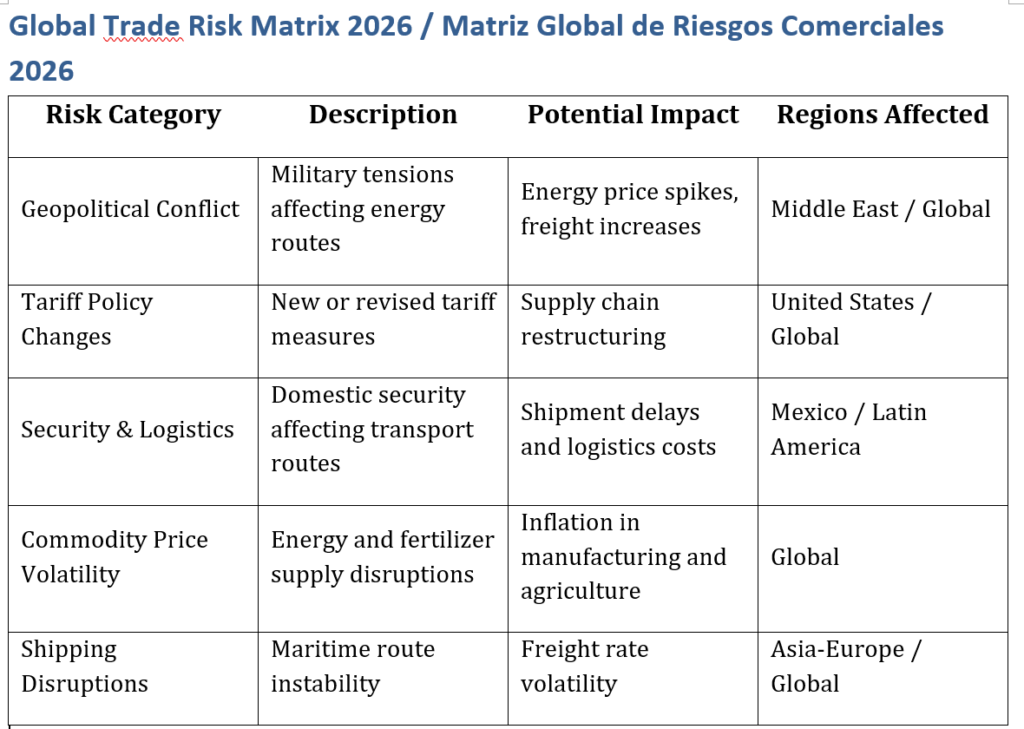
Energy and fertilizer shocks remain one escalation away from feeding directly into customs value, margins and landed cost
Source: Reuters reporting on Iran war spillovers, Hormuz exposure and fertilizer impacts, 17-03-2026 to 25-03-2026
Operational Explanation: Around one-fifth of global oil and LNG flows still move through the Strait of Hormuz, which makes Middle East instability a trade-cost issue even for companies with no direct regional exposure. Reuters reporting also highlighted the way conflict spillovers affect fertilizer supply, agricultural pricing and food-security concerns. That matters because energy costs do not stay inside the energy sector. They flow into transport, chemicals, packaging, industrial inputs and freight assumptions. When those prices move abruptly, customs values, supplier adjustments and purchase-price revisions become more vulnerable to inconsistency.
SEMUDMEX Practical Risk Assessment: SEMUDMEX’s position is that energy shocks should also be treated as customs risk. Importers under pressure to switch suppliers or renegotiate prices quickly often create valuation inconsistencies without realizing it. That is where macro volatility becomes a customs exposure.